Standardizing IT across accounting firms in a PE portfolio is one of the most underestimated operational lifts in private equity.
You have acquired five accounting firms in 18 months. Each one came with its own servers, its own software stack, its own IT vendor, and its own way of doing things. Now you are trying to get them all on the same page.
This is the platform consolidation challenge, and getting it right is the foundation for everything else you want to do operationally.
The Challenge of Standardizing IT Across Accounting Firms in a PE Portfolio
On paper, consolidating technology across a portfolio of accounting firms sounds straightforward. Pick a platform, migrate everyone, move on.
In practice, it is much harder. Every firm you acquire brings a unique combination of:
- Applications (Drake, Lacerte, ProSeries, UltraTax)
- Workflows and file structures
- User habits and access patterns
- IT maturity (some firms run modern cloud, others have aging local servers)
The diversity is the problem. When every firm runs on a different setup, you cannot manage them as a portfolio. You cannot enforce consistent security policies. You cannot predict costs. And when something goes wrong at one firm, the fix does not translate to any other firm in the group.
Standardizing IT across your accounting firms is not a nice-to-have. It is the foundation for everything else in your PE portfolio.
Why “One Size Fits All” Fails in Accounting
Here is where many PE operators make their first mistake: they assume standardizing IT means forcing every accounting firm onto identical software.
Accounting firms are not interchangeable. One firm may have built its entire practice around Drake. Another runs Lacerte. A third uses ProSeries. These are not casual preferences. Accountants build years of muscle memory, templates, and workflows around their tax software.
Forcing a firm to switch applications mid-acquisition creates:
- Enormous friction during an already disruptive period
- Slower productivity while staff learns new tools
- Risk of losing key staff who refuse to switch
The smarter approach is to standardize the infrastructure, not the applications. Every firm gets the same cloud environment, the same security tools, the same backup and recovery systems, the same monitoring, and the same help desk. But each firm keeps the tax software it already knows.
This gives you consistency and control at the PE portfolio level without disrupting the daily work that generates revenue.
For a comparison of tax software options and hosting requirements, see our guide on TaxAct vs Drake vs ProSeries.
What’s the best cloud setup for a multi-location accounting firm?
One dedicated private server hosting every office, which Verito provides, beats per-location infrastructure. All locations work in the same environment with the same versions, role-based access controls who sees what, and a new office or acquisition onboards by adding users instead of buying hardware. Performance stays consistent because nothing depends on any office’s local network.
The version problem disappears first. When every office works in the same hosted environment, there is no office still running last year’s Drake, no per-location patch schedule, and no integration that works in one city and fails in another.
Acquisitions get materially cheaper to absorb. Standing up a new office means creating users and assigning permissions, not specifying, shipping, and configuring hardware. The acquired firm’s data moves once, into the same controlled environment as every other office.
Performance consistency is the quiet win. Each office’s experience depends on its internet connection and nothing else. A branch that loses its building in a storm works from home at full speed the same afternoon.
A Phased Approach to Standardizing IT Across Accounting Firms
Rushing standardization creates more problems than it solves. A phased approach keeps the process manageable and limits disruption to client-facing work.
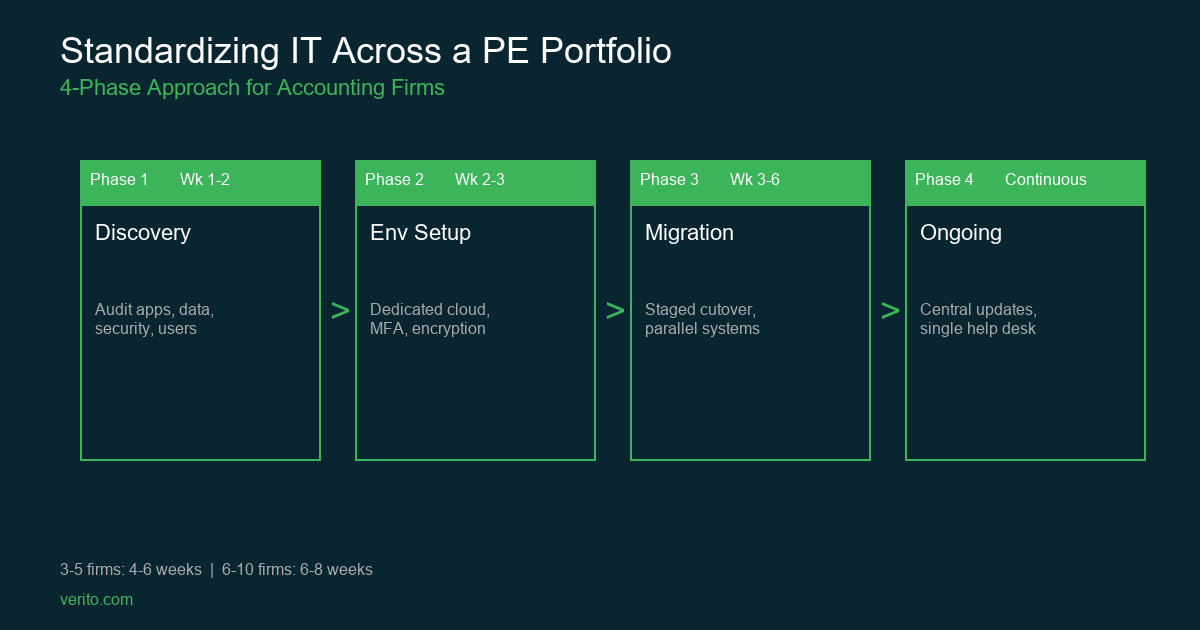
Phase 1: Discovery (Week 1-2)
Before changing anything, you need to know what you are working with. A thorough discovery process covers every accounting firm in the PE portfolio:
- What applications does each firm run?
- How is data stored and backed up?
- What security tools are in place, if any?
- How many users need access, and from where?
- Are there compliance requirements specific to the firm’s client base?
- What are the current IT costs, including subscriptions, hardware, and vendor contracts?
This discovery phase produces a clear inventory and identifies the gaps between where each firm is today and where it needs to be.
Phase 2: Environment Setup (Week 2-3)
With the inventory in hand, the next step is building the standardized environment. You set up dedicated cloud infrastructure for each firm with shared components pre-configured:
- Security monitoring and threat detection
- Encrypted storage for all client data
- Automated backups with tested recovery
- Multi-factor authentication on all accounts
- Centralized management tools for portfolio-wide visibility
Each accounting firm gets its own isolated environment within the platform. Client data from Firm A is never mixed with client data from Firm B. But from a management perspective, all environments are monitored and secured through a single pane of glass.
Managing a PE portfolio of accounting firms? Verito standardizes IT across portfolios in weeks. Talk to our team about your portfolio.
Phase 3: Migration (Weeks 3-6)
Migration is where the rubber meets the road. Each firm’s applications, data, and user accounts move from their legacy setup to the new standardized environment.
Good migration planning means:
- Scheduling moves around each firm’s busy periods (never during tax season)
- Running parallel environments for a short overlap period
- Testing every application in the new environment before cutting over
- Training staff on any changes to login or file access
- Having support available during the first week after each firm goes live
Firms can be migrated in parallel or sequentially, depending on PE portfolio size and IT capacity. Either way, the goal is minimal disruption to client work.
Learn more about what a smooth migration looks like in our guide: How CPA Firms Are Solving Their Biggest IT Problem.
Phase 4: Ongoing Management
Once every accounting firm in the PE portfolio is on the standardized IT platform, the real value starts compounding:
- Updates and security patches roll out across the entire portfolio at once
- New acquisitions can be onboarded to the same platform in days, not weeks
- Cost tracking is centralized and predictable
- You have a single view into the health, performance, and security of every firm
This is where you start seeing the operational leverage that justified standardizing IT in the first place.
What “Done” Looks Like
When standardizing IT across your accounting firms is complete, here is what you should have across your entire PE portfolio.
Unified Management
One platform, one dashboard, one support team. No more juggling five different IT vendors with five different escalation paths.
Consistent Security
Every firm meets the same security baseline. Multi-factor authentication, encrypted storage, regular backups, and continuous monitoring. This is not optional when you are holding client tax data across multiple firms.
Predictable Costs
No more surprise hardware failures, emergency vendor calls, or one-off license renewals. Your IT spend becomes a clean per-firm, per-user line item that scales with the portfolio.
For details on what managed IT should cost, see Managed IT Services for Accounting Firms: What It Should Cost.
Faster Onboarding for New Acquisitions
The next firm you acquire can be on the standard platform within two to three weeks. The playbook already exists. The environment is ready. The support team knows the drill.
Compliance Readiness
With consistent infrastructure and security across the PE portfolio, meeting requirements like the FTC Safeguards Rule and IRS Publication 4557 becomes a portfolio-level activity. Not a firm-by-firm scramble.
Timeline Expectations
PE operators often ask how long standardizing IT across their accounting firms takes. The honest answer depends on portfolio size and the state of each firm’s existing technology.
Here is a realistic frame:
- 3-5 firms: Four to six weeks from discovery to all firms live
- 6-10 firms: Six to eight weeks, with firms migrating in waves
- 10+ firms: Phased rollout with 3-4 firms per wave
The key point: this is measured in weeks, not months. A good technology partner with experience in multi-firm accounting environments can move quickly without cutting corners.
Do Not Wait Until It Breaks
The most common mistake PE operators make with accounting firm IT is treating it as a later problem. They close acquisitions, focus on revenue and client retention, and plan to “deal with IT eventually.”
Eventually usually arrives as a security incident, a failed server, or a compliance audit that exposes gaps across the portfolio. By then, the fix is urgent, expensive, and disruptive.
Standardizing IT early, ideally within the first 90 days of each acquisition, is cheaper, smoother, and far less risky than waiting.
See what strong IT infrastructure looks like in our ranking of the best IT support providers for accounting firms.
Frequently Asked Questions
How long does it take to standardize IT across accounting firms in a PE portfolio?
For a PE portfolio of three to five accounting firms, expect four to six weeks from discovery to all firms live on the standardized platform. Larger portfolios may run six to eight weeks, with firms migrating in waves.
Do accounting firms have to switch their tax software during IT standardization?
No. The smarter approach is to standardize the infrastructure, not the applications. Each firm keeps its preferred tax software (Drake, Lacerte, ProSeries, etc.). The cloud environment, security, backups, and support are what become uniform.
What is the biggest risk of delaying IT standardization in a PE portfolio?
A security incident or compliance gap at one accounting firm that creates liability for the entire PE portfolio. When every firm runs on a different setup, you cannot enforce consistent security policies or respond quickly to threats.
Can IT standardization happen during tax season?
It can, but it should not. Schedule migrations for off-peak periods (May through December). Discovery and planning can happen anytime, but the actual cutover should avoid January through April.
What does standardized IT cost per accounting firm?
Costs vary by firm size and user count. However, standardized IT typically delivers predictable per-user pricing that is lower than the combined cost of individual IT vendors, emergency fixes, and separate security tools across the PE portfolio.
Verito works with PE groups to standardize IT across accounting firm portfolios. Dedicated environments, consistent security, and predictable costs, delivered in weeks. See how it works.