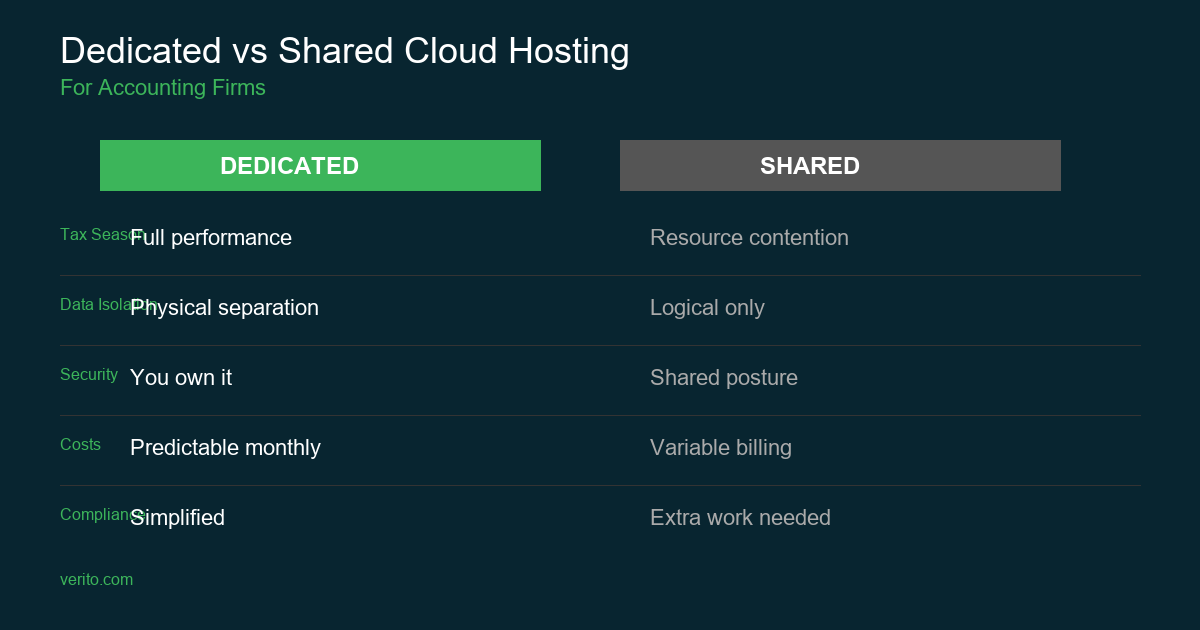
Shared hosting is the cheapest option, but it puts your firm’s data on the same server as strangers, which makes IRS and FTC compliance hard to prove. This trade-off is the heart of choosing cloud hosting for a tax firm. A dedicated private server isolates your firm on its own hardware, the cleaner fit for tax and accounting work. For most firms with three or more preparers, dedicated private cloud hosting is the right call.
Key takeaways
- Shared hosting splits one server across many tenants; a dedicated private server is reserved for your firm alone.
- Dedicated isolation gives a clean answer to IRS Pub 4557 and FTC Safeguards questions about where client data lives.
- Verito runs dedicated private cloud on NVMe storage, roughly 35% faster than shared, with 100% uptime since 2016.
- VeritComplete starts at $129/user/mo; VeritSpace at $69/user/mo.
What is shared hosting, and why is it risky for a tax firm?
Shared hosting places many separate businesses on one physical server and splits its memory, storage, and processing among them. It is cheap because the cost is divided across many tenants. For a firm holding tax returns and Social Security numbers, the risk is that you cannot see or control who shares that server.
Two problems follow from that. One tenant’s traffic spike or runaway process can slow everyone down, the so-called noisy-neighbor effect. And a security gap in a neighbor’s account sits inside the same environment as your client data. For a brochure website that is fine. For a practice that handles taxpayer data, it is a weak starting position.
What should you look for when choosing a dedicated server for your accounting practice?
Look for single-tenant hardware, sizing matched to your apps and user count, SOC 2 Type II infrastructure, daily backups, and support that knows tax software. Confirm the server is sized for concurrent users during peak season, not averages. And get the uptime commitment in writing before you sign anything.
The checklist in practice:
- Single-tenant hardware. The server is yours alone, so no other firm’s workload can slow it.
- Sizing matched to the firm. Concurrent users during peak weeks, app count, and database size set the spec, not an average month. For sizing guidance, see running multiple tax apps on one server.
- SOC 2 Type II infrastructure. Ask for the report, not the logo.
- Daily backups with retention you can state. Know how many days back you can restore and who tests it.
- Tax-software support. The team should know Drake, Lacerte, ProSeries, UltraTax, and QuickBooks by name, because generic triage burns billable hours.
Then get the uptime commitment in writing. A provider confident in its record will put a number in the agreement.
What is a dedicated private server?
A dedicated private server is hardware reserved for one firm. No other tenant shares its memory, storage, or operating system, so your performance and your security boundary belong only to you. This is the isolation model behind Verito’s VeritSpace hosting, and it is what most compliance-minded firms move toward.
The practical benefits are concrete. Your resources do not fluctuate because a stranger got busy. Your data sits behind a boundary you can document for an auditor. And the environment can be configured for the exact mix of software your firm runs, instead of a lowest-common-denominator template.
How is VPS hosting different from a dedicated server?
A VPS, or virtual private server, splits one physical machine into walled-off virtual slices with reserved resources, but the hardware underneath is still shared with other tenants. It fixes the speed problem of shared hosting. It does not give you the clean single-tenant isolation that a dedicated private server does.
A VPS is a reasonable middle step for a lighter workload. For a firm that wants both predictable performance and a simple isolation story for the IRS and FTC, the dedicated private server is the cleaner answer. Here is how the four models line up.
| Factor | Shared | VPS | Dedicated private server | On-premise |
|---|---|---|---|---|
| Compliance posture | Hard to document | Partial | Clean isolation for 4557 / FTC | Yours to prove alone |
| Security boundary | Shared with unknowns | Virtual, shared host | Single-tenant | Single-tenant, all on you |
| Performance under load | Noisy-neighbor risk | Reserved resources | ~35% faster than shared | Limited by your hardware |
| Uptime | Depends on the box | Better, shared host | 100% since 2016 (Verito) | Depends on your building |
| Cost model | Lowest | Moderate | Predictable per user | High upfront plus staff |
| Scaling | Crowds the shared box | Resize the slice | One server, scales vertically to 100+ | Buy more hardware |
| Maintenance | Provider | Provider | Provider, white-glove | Entirely your firm |
Is cloud hosting the same as a dedicated server?
No. Cloud hosting is a delivery model, not a single architecture, so a cloud server can be shared, virtual, or dedicated underneath. Moving to the cloud gets you remote access and offloaded maintenance. Whether it gets you isolation depends entirely on whether that cloud server is private to your firm.
This is the distinction most comparison articles miss. “Cloud” answers where the server sits and how you reach it. “Shared or dedicated” answers who else is on it. Verito runs dedicated private cloud servers, so you get the remote access and hands-off maintenance of cloud with the isolation of dedicated hardware.
Why is hosting type a compliance decision, not just a performance one?
Because tax preparers are financial institutions under the FTC Safeguards Rule and must safeguard client data under IRS Publication 4557. A shared environment makes it hard to prove where data lives and who can reach it. A dedicated private server gives you a documented, single-tenant answer that holds up with an auditor or insurer.
IRS Publication 4557 calls for documented access controls and a written security plan. The FTC Safeguards Rule (16 CFR Part 314) makes encryption and monitored access enforceable, and the Gramm-Leach-Bliley Act sits underneath both. On a dedicated server you can say client data sits in an isolated environment, encrypted in transit and at rest, with access you control. On a shared box, you cannot.
I value the robust firewall that Verito provides, helping me maintain compliance with WISP and ensuring the protection of client data.
Carrol G., Owner, Gatlin Tax, Ltd · G2, Nov 2025
How do virtual servers improve data security for accounting firms?
A hosted virtual server centralizes client data in one controlled environment instead of scattering it across laptops. Encryption protects files at rest and in transit, MFA gates every login, and access logs show who touched what. If a laptop is lost or fails, the data never lived on it.
Centralization is the security feature firms underrate. When client data lives on laptops, every device is a separate breach risk with its own patch level and its own owner. On a hosted server there is one environment to harden, one place encryption applies, and one access log to review.
The practical wins follow from that. MFA gates every login no matter where the person sits. Role-based permissions decide who sees which clients. And when a laptop is lost, the firm’s exposure is a password reset, not a disclosure letter.
How does a dedicated server hold up during tax season?
Tax software is resource-hungry, and firms run a tax suite, QuickBooks, and a document manager at once across every preparer. On shared infrastructure that load competes with other tenants. On a dedicated private server the resources are yours, which is why Verito measures roughly 35% faster load times than shared hosting.
The second week of April is where the difference shows. Storage across VeritSpace runs on NVMe by default, which is where the day-to-day speed firms notice comes from. Combined with the 100% uptime Verito has held since 2016, that means the system is fast and up when deadlines are tightest.
“I also appreciate the system’s reliability, as there have been practically no downtimes in the past year.”
Nassir H., Owner, All Tax NY Inc. · G2, Oct 2025
When does a firm outgrow shared hosting?
The honest answer is workload, not headcount. A dedicated server costs about the same whether one person or five use it, because the hardware is a fixed cost. That is why the per-user math improves once three or more preparers work at once. Solos who want the isolation are welcome too.
A few signals you have outgrown shared hosting:
- Two or more preparers are in the software at the same time during busy weeks.
- You run a full stack at once: tax suite, QuickBooks, and a document or practice-management tool.
- An auditor, a client, or a cyber-insurance form has asked where your data lives.
- The system slows down at the worst possible time and you cannot tell why.
“We switched to Verito from RightWorks and immediately saved about $100 per month.”
Kristin M., Owner, Gradient Accounting LLC · G2, Jul 2025
What does hosting actually cost over three years?
Sticker price is the wrong lens. The real number is total cost of ownership: the hardware, the refresh every few years, power and cooling, patching, backups, and the staff time an on-premise server quietly eats. A flat per-user monthly model folds all of that in and is usually lower once the hidden costs are counted.
| Cost element | On-premise server | Dedicated private cloud |
|---|---|---|
| Upfront hardware | Large capital purchase | None |
| Refresh every 3-5 years | Repeat purchase | Included |
| Power, cooling, space | Your office, your bill | Included |
| Patching and maintenance | Your staff or MSP | Included |
| Backup and recovery | You build and test it | Managed |
| Predictability | Lumpy, capital-heavy | Flat monthly, per user |
Which hosting should your firm choose?
For three or more preparers who want compliance and performance without managing IT, VeritComplete bundles dedicated hosting and managed IT from $129 per user per month. Firms with their own IT take VeritSpace from $69. Both move you off shared infrastructure, with sub-60-second human support and 24-to-48-hour migration.
You do not outgrow it either. A dedicated private server scales vertically, you add RAM, CPU, and NVMe to the same machine, so one isolated server handles 100+ concurrent users as the firm grows, with no second environment to manage. What you feel day to day is the support: a real person answers in under 60 seconds, with no phone trees, and 92% of issues resolve on the first touch, against an industry average of 64%. Annual pricing locks in your rate, with month-to-month also available, and more than 1,000 firms run on Verito today. To see whether a dedicated private server fits your stack and budget, book a VeritComplete demo.
Sources
- IRS Publication 4557
- FTC Safeguards Rule (16 CFR Part 314)
- Customer quotes: Verito verified review bank (G2), via /proof