

You might not be using AI, but you are about to pay for it.
The surge in AI infrastructure demand is absorbing manufacturing capacity that also affects everyday server components like memory.
As a result, on-premise server costs for CPA firms are rising sharply, turning a routine hardware refresh into a major capital expense.
If your firm is planning a server refresh in 2026, the quote you receive will likely be significantly higher than the one you paid three or five years ago.
For most accounting firms, this sticker shock is confusing. You aren’t buying Nvidia superchips or training Large Language Models. You simply need a reliable machine to run QuickBooks Desktop, host your tax software, and store client files.
Yet, on-premise server costs are climbing because the global supply chain has fundamentally shifted. The manufacturing resources once dedicated to “boring” office servers are being aggressively reallocated to feed the AI boom.
This is the hidden “AI Tax.” It is an invisible surcharge on standard business hardware, and for CPA firms operating on traditional refresh cycles, it is about to make owning your own metal much more expensive.
To understand why your next Dell or HP server quote is spiking, you have to look at what is happening inside the factories that build the components.
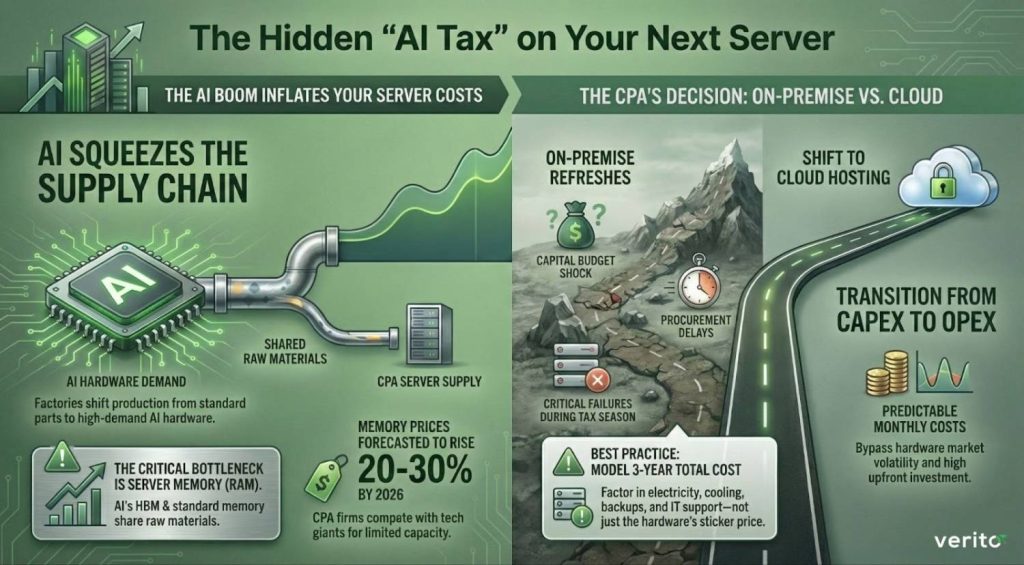
The AI industry is currently consuming a massive amount of the world’s computing resources. While this sounds like a problem for tech giants, it directly impacts the availability and price of the basic components inside a standard small business server.
The most critical bottleneck is memory (RAM).
Why AI demand affects “boring” office servers
Every server relies on memory to run applications smoothly. For years, this memory (typically DDR4 or DDR5) was abundant and relatively cheap. But the new generation of AI servers requires a different, high-performance type of memory called HBM (High Bandwidth Memory).
Here is the problem: HBM and standard server memory are made from the same raw material: silicon wafers.
- The Wafer Squeeze: Manufacturing HBM is resource-intensive. Producing a single HBM chip consumes roughly three times the wafer capacity of a standard memory chip.
- The Manufacturer Pivot: To meet the insatiable demand from AI companies, major manufacturers like Samsung, SK Hynix, and Micron are shifting their production lines. They are allocating more silicon wafers to HBM and fewer to standard server memory.
This creates a simple supply-and-demand trap. There is less capacity available to build the standard memory sticks your office server needs. As supply shrinks, prices for “boring” DDR5 memory have already surged. Forecasts predict prices could rise another 20-30% heading into 2026.
For a CPA firm, this means you are competing for silicon with the world’s largest AI companies, without even realizing it.
What this means for CPA firms planning a server refresh
The trickle-down effect of this supply crunch is that the simple act of replacing a server is becoming harder and more expensive. For accounting firms accustomed to a predictable 3-to-5-year hardware lifecycle, the market has shifted.
If you are planning a server refresh in 2026, here is the new reality:
- Capital budget shock: If you budgeted for your new server based on prices from your last refresh cycle, you are likely underfunded. With server hardware prices 2026 trending upward due to component scarcity, firms must prepare for a significantly higher initial capital expense (CapEx) to get the same level of performance they had previously.
- Procurement delays and backorders: In previous years, you could order a server and have it deployed within weeks. Now, because manufacturers are prioritizing hyperscale AI clients, “boring” orders for standard office servers often face longer lead times. This creates a dangerous gap if you are trying to upgrade right before a deadline.
- Single point of failure during tax season: The risk of relying on a single physical box has always existed, but the stakes are higher now. If a critical component like a memory module fails in March, getting a replacement part overnight is no longer guaranteed. Tax season IT capacity planning now requires you to account for these supply chain vulnerabilities.
The 2026 server decision framework for CPA firms
Should you buy a new server in 2026 or stop owning it?
For many partners, the rising cost and complexity of hardware ownership are prompting a re-evaluation. Is it still financially logical to own depreciating metal, or is it time to consider a dedicated cloud server for accountants?
Before you sign a quote for new hardware, ask these six questions. If you answer “No” to more than two, purchasing a new on-premise server may be a strategic mistake.
- Is your next mandatory refresh scheduled within the next 12 months?
- Would a 24-hour downtime event during March or April be catastrophic for your firm?
- Do you want predictable, flat-rate IT costs instead of spiking capital expenses?
- Do you rely heavily on QuickBooks Desktop or legacy tax software?
- Do you have automated offsite backups that are tested at least quarterly?
- Are you fully comfortable owning the liability for data security compliance (FTC Safeguards, WISP)?
How cloud hosting changes the cost equation
When you purchase a physical server, you are locking in a fixed capacity at today’s inflated prices. You bear the full brunt of the component shortage immediately.
Cloud hosting fundamentally shifts this model from a capital expenditure (CapEx) to an operational expenditure (OpEx). Instead of fighting for supply allocation yourself, you leverage the economies of scale of a provider.
This is where Verito enters the picture.
By moving your firm to cloud accounting software hosting, you bypass the volatility of the hardware market entirely. You are no longer purchasing a depreciating asset; you are subscribing to a guaranteed outcome.
- Economies of Scale: Because we purchase infrastructure at an enterprise level, we absorb the component price fluctuations that would otherwise wreck a small firm’s IT budget.
- Predictable Monthly Spend: You get a flat, transparent monthly rate. There are no surprise invoices because a RAM stick failed or a hard drive needs replacing.
- Built-in Redundancy: Verito’s infrastructure is built on enterprise-grade private servers with full redundancy. We don’t just store your data; we ensure it is accessible even if physical hardware fails (something that is prohibitively expensive to replicate in a local server closet).
- Compliance Alignment: We handle the heavy lifting for IRS Pub 4557 and FTC Safeguards Rule compliance, reducing your liability exposure.
If you stay on-prem, do this before you buy anything
If you decide that purchasing a new office server is still the right move for your firm in 2026, proceed with caution. The market has changed, and the old “buy and forget” approach is risky.
Protect your firm by following this checklist before signing any purchase order:
- Get multiple quotes: Do not rely on a single vendor. Prices are fluctuating weekly due to the memory supply crunch; compare at least three sources to ensure you aren’t paying a “panic premium”.
- Lock memory pricing early: If you get a quote you like, ask the vendor to lock the pricing for 30 days. Component costs can rise significantly between the quote date and the invoice date.
- Model the 3-year total cost: Don’t just look at the hardware sticker price. Add the cost of electricity, cooling, independent backups, and outsourced IT support maintenance for 36 months. The “cheaper” local server often becomes more expensive over time.
- Stress-test backups: Before relying on a new box, verify your disaster recovery plan. If the server motherboard dies in April, how long exactly until you are back up?.
Plan tax season capacity: Ensure your new server has enough overhead to handle peak loads. Upgrading RAM mid-tax season in 2026 might be impossible if backorders persist.
Don’t let a hardware refresh risk your tax season.
If your server refresh is coming up in the next 12 months, get a second opinion before approving a six-figure IT decision.
Frequently Asked Questions
1. Why are server memory prices increasing?
Prices are rising because manufacturers are reallocating silicon wafers to build High Bandwidth Memory (HBM) for AI chips. This leaves less production capacity for standard server memory (DDR5), creating a shortage that drives up costs.
Sponsored by Verito Verito hosts Drake, Lacerte, UltraTax, and QuickBooks on private dedicated servers — with 24/7 support from techs who actually know tax software. Used by 1,000+ accounting firms. See plans from $69/user →2. What is HBM and why does it affect DDR5?
HBM (High Bandwidth Memory) is specialized memory used in AI infrastructure. It requires significantly more raw materials to build than standard DDR5 memory. As demand for HBM explodes, fewer resources are available to make the standard memory CPA firms use.
3. Will server prices come down soon?
It is unlikely in the short term. The demand for AI infrastructure is projected to grow through 2026, meaning the “squeeze” on standard server components will likely persist or worsen before it improves.
4. How often should a CPA firm replace its server?
The typical cycle is 3 to 5 years. However, stretching a server beyond 5 years increases the risk of hardware failure and security vulnerabilities, especially as operating systems stop supporting older hardware.
5. Is cloud hosting safer for accounting firms?
Generally, yes. A dedicated private cloud provider like Verito offers enterprise-grade security, including SOC 2 Type II certification, daily backups, and physical data center security that is difficult for a small firm to match on-premise.
6. What happens if our server fails during tax season?
If you are on-premise, you may face days of downtime while waiting for parts or a technician. In a hosted environment, redundancy is built-in; if one server node has an issue, your workload shifts to another instantly, keeping your firm operational.
7. Is QuickBooks Desktop hard to move to the cloud?
No. Solutions like Verito’s allow you to run the full desktop version of QuickBooks in the cloud. It looks and feels exactly like it does on your local PC, but it is accessible from anywhere.
8. How should CPA firms budget for IT going forward?
Move away from lumpy Capital Expenditures (CapEx) for hardware. Shift toward a predictable Operational Expenditure (OpEx) model, such as managed hosting, which combines infrastructure, security, and support into a single monthly line item.