

Your accounting firm is one bad Tuesday away from losing everything.
Most firms don’t think seriously about their IT setup until something goes wrong. A server goes offline two days before an April filing deadline, a phishing email locks up QuickBooks, or a compliance audit surfaces a missing Written Information Security Plan
By that point, whatever fix is available is going to be expensive, rushed, and stressful.
This article cuts through the confusion around outsourced IT support for tax and accounting practices. It explains what managed IT services for accounting firms actually include, gives you real per-device pricing benchmarks for 2026, and helps you decide whether your firm genuinely needs a managed services model or if you can get away with something simpler.
The short answer to the Managed IT pricing question:
For most accounting and CPA firms in 2026, managed IT services cost between $79 and $199 per device per month, depending on the tier of coverage. Entry-level compliance and monitoring starts at $79 per device. Full-spectrum managed security with white-glove IT support runs $199 per device. Firms with two or more staff and active client data, the majority of practices with real compliance exposure, typically land in the $149 per device range.
Table of Contents Show
What This Guide Covers
- Break/fix IT looks cheaper until you factor in unplanned downtime, no compliance support, and zero tax-season guarantees.
- A proper managed IT package includes 24/7 monitoring, helpdesk support, patch management, EDR, managed backups, MFA, and FTC Safeguards/IRS 4557 compliance documentation.
- Most CPA firms with 2+ staff and client data are legally required to have documented security controls under the FTC Safeguards Rule.
- Managed IT for accounting firms costs $79 to $199 per device per month in 2026, depending on tier and compliance depth.
Verito’s VeritGuard offers three tiers: Essentials at $79/device, Pro at $149/device, and Elite at $199/device, all month-to-month with no long-term contract. - The right provider for an accounting firm knows Drake, Lacerte, QuickBooks Desktop, and UltraTax, not just Windows and Microsoft 365.
What are Managed IT Services for an Accounting Firm?
Accounting firms operate in one of the most compliance-heavy, security-sensitive, and deadline-driven environments in professional services. Managed IT is the model specifically designed for that reality.
At its core, managed IT means outsourcing your firm’s technology operations to a third-party provider on a flat monthly fee. Unlike break/fix support, where you call someone when something breaks and pay by the hour, managed IT is a proactive arrangement. The provider monitors your systems around the clock, patches vulnerabilities before they become breaches, manages backups, and ensures your infrastructure stays aligned with regulatory requirements like the FTC Safeguards Rule and IRS Publication 4557.
For accounting firms, the standard components of a managed services engagement typically include:
- 24/7 remote monitoring and management (RMM)
- Unlimited helpdesk support
- Endpoint security including endpoint detection and response (EDR)
- Patch management across operating systems and software
- Managed backups and disaster recovery
- Multi-factor authentication (MFA) deployment and management
- Compliance documentation support such as WISP preparation
- Security awareness training for staff
The distinction between a general-purpose IT provider and an accounting-specific one is worth understanding before you evaluate anything else. A generalist MSP knows Windows and Microsoft 365.
An accounting-focused provider knows what a ProSeries lock file is, understands why QuickBooks Desktop behaves differently in a multi-user cloud environment, and has engineers who can distinguish between a Lacerte sync error and a network issue at 9 p.m. on April 14th.
Break/Fix vs. Managed IT: The Real Cost Comparison for CPA Firms

Break/fix has survived as a model for one reason: it looks cheaper upfront. You pay nothing when everything works, and you pay an hourly rate when it doesn’t. For a solo practitioner with one device and minimal compliance exposure, that math can make sense.
For almost everyone else in accounting, math breaks down under pressure. According to Mordor Intelligence’s Analysis, the global managed services market is valued at approximately 430 billion dollars in 2026, growing steadily as organizations shift away from reactive IT precisely because unplanned downtime is expensive. Here’s how the two models compare for a typical CPA firm:
| Factor | Break/Fix | Managed IT |
|---|---|---|
| Cost model | Hourly ($125-$250/hr) | Flat monthly, per device |
| Billing trigger | When something breaks | Fixed, regardless of issues |
| Proactive monitoring | No | Yes |
| Patch management | On request | Automated and continuous |
| Compliance help | No | FTC Safeguards, IRS 4557 built in |
| Tax season priority | No SLA guarantee | Contractual SLA |
| Budget predictability | Unpredictable, spikes during incidents | 100% predictable monthly cost |
| Best for | True solo, minimal compliance exposure | 2+ person firms with client data |
The case for managed IT is not just about preventing disruptions, though that matters enormously. The average company experiencing a ransomware attack faces 24 days of downtime, according to Statista’s Analysis. For an accounting firm, 24 days of lost access to tax software and client files during peak season is not a recoverable event. It is an existential one.
Based on Verito’s client data, a three-person accounting firm losing access to tax software during peak season loses approximately $350 per hour in billable productivity. For a five-person firm, that figure rises to $1,500 to $2,250 per hour once overtime and recovery costs are factored in. These estimates reflect billable rate loss only. However, Reputational damage, which does not appear on any invoice, consistently accelerates client attrition following a visible incident.
How Much Do Managed IT Services Cost for Accounting Firms in 2026?
Pricing in the managed services space has become more standardized, and accounting firms have more visibility into what they should expect to pay than they did even two or three years ago. The per-device model is the most common pricing structure for firms in the 1 to 50-employee range.
Across the industry, accounting-focused managed IT runs from roughly 79 dollars per device per month at the entry level to 200 dollars per device per month for full-spectrum security, compliance, and white-glove support.
The difference between tiers reflects what is actually included: how deeply the provider monitors your environment, whether compliance documentation is maintained ongoing or just generated once, and how fast you get a real human on the phone when something goes wrong.
Here is how Verito’s VeritGuard managed IT service is structured:
| Plan | Monthly Price | Best For |
|---|---|---|
| VeritGuard Essentials | $79/device | Solo practitioners and small firms needing core IRS compliance and IT support |
| VeritGuard Pro | $149/device | Growing firms needing enhanced threat protection, anti-phishing, and immutable backups |
| VeritGuard Elite | $199/device | Established firms requiring full compliance infrastructure, advanced security, and white-glove coverage |
There is a one-time setup fee of 100 dollars per device, which covers initial configuration, security controls deployment, and employee onboarding. All VeritGuard plans run month-to-month with no long-term contract, no cancellation penalties, and no surprise fees.
If you want to compare all three VeritGuard tiers in detail before booking a call:
See VeritGuard plans and pricing→
What’s Included in Each VeritGuard Tier?
Each tier is designed around a specific risk profile and compliance stage, so the right choice depends less on headcount and more on what your firm is actually responsible for protecting.
1. VeritGuard Essentials ($79/device/month)
The VeritGuard Essentials tier covers the fundamentals that every accounting firm with more than a handful of client records needs in place. This includes:
- 24/7 remote helpdesk access
- Endpoint monitoring and patch management
- Managed backups
- MFA deployment
- FTC Safeguards Rule compliance assistance
- IRS Publication 4557 alignment
- WISP documentation support
For firms that have been operating without a formal IT structure, Essentials is the most logical entry point.
2. VeritGuard Pro ($149/device/month)
The VeritGuard Pro tier builds on the Essentials foundation with a meaningfully different security posture. Added protections include:
- Full endpoint detection and response (EDR)
- AI-driven anti-phishing software that stops threats before they reach inboxes
- 24/7 threat monitoring
- Offline immutable backups that are ransomware-proof by design
- Security awareness training for staff
For context on why this matters: 65 percent of financial services organizations reported being hit by ransomware in 2024, according to Sophos’ 2024 State of Ransomware Report, the highest rate since the firm began tracking the metric. Essentials protects against the basics; Pro is built for the threat environment that actually exists today.
3. VeritGuard Elite ($199/device/month)
The VeritGuard Elite plan is the full-coverage tier. It includes everything in Pro, plus:
- Comprehensive IT support across all technology (not just security-related issues)
- Annual risk assessments
- Full WISP maintenance and ongoing updates
- Sub-1-minute average support response times delivered by VeritCertified™ engineers.
VeritCertified is Verito’s internal engineer certification program, requiring demonstrated proficiency in secure cloud architecture, accounting software troubleshooting, cybersecurity operations, and compliance awareness before any engineer assists a client. It is what drives Verito’s 92 percent First-touch Resolution rate, 95 NPS, and 100 percent uptime maintained since 2016. When you call on April 14th, you get someone who already knows what Drake tax software looks like.
How Verito Compares to Other IT Providers for Accounting Firms
Pricing alone does not tell the whole story, but transparency does. Here is how Verito’s VeritGuard stacks up against two other names that frequently appear in conversations about accounting-focused IT support.
1. Rightworks
Rightworks is one of the most established platforms in the accounting IT space, particularly popular with Drake Tax users. Their entry-level hosting plan starts at around 45 dollars per user per month, but that covers cloud-hosted application access, not fully managed IT.
Their comprehensive IT management and security offering requires a separate enterprise quote rather than a published tier. There is also no free trial available, and cancellation within the first 30 days incurs a fee.
For firms already embedded in the Drake ecosystem, Rightworks is a capable option, but firms that need transparent, fully-tiered managed IT pricing and month-to-month flexibility will find the structure limiting.
2. Ace Cloud Hosting
Ace Cloud Hosting is a well-resourced provider serving over 20,000 businesses globally, with QuickBooks hosting starting at 35 dollars per user per month. Managed security and fully managed IT are handled through custom quotes rather than published tiers, which makes budget planning more difficult for smaller firms.
Note: Competitor pricing reflects publicly available information as of early 2026 and may vary. Verify current pricing directly with each provider.
Here is where the providers differ most meaningfully:
| Verito VeritGuard | Rightworks | Ace Cloud Hosting | |
|---|---|---|---|
| Managed IT pricing | Published tiers: $79/$149/$199 per device | Quote-based for managed IT | Custom quote required |
| Contract flexibility | Month-to-month, cancel anytime | 30-day cancellation fee applies | Varies by plan |
| Free trial | 15-day free trial | No free trial; 30-day cancellation fee applies | 7-day trial (VDI only) |
| Engineer training | VeritCertified: accounting software-specific | General accounting platform expertise | General IT support |
| First Touch Resolution | 92% | Not publicly disclosed | Not publicly disclosed |
| SOC 2 Type II | Yes | Yes | Yes |
| Uptime track record | 100% since 2016 | 99.99% SLA | 99.99% SLA |
| Compliance included | FTC Safeguards + IRS 4557 + WISP | WISP add-on available | Add-on/quote-based |
Note: Table reflects publicly available information as of March 2026. Competitor SOC 2 and resolution rate data based on published documentation; firms should verify directly.
The comparison is not about which provider is “bad.” Both Rightworks and Ace Cloud Hosting serve real use cases well. The distinction is specificity.
Verito’s entire model, from engineer certification to compliance infrastructure to pricing structure, is built exclusively around the way accounting firms operate. That focus is what produces metrics like 92 percent First-touch Resolution and 100 percent uptime through every tax season since 2016.
When Is Break/Fix Enough, and When Do You Need Managed IT?
This question deserves a direct answer rather than a sales pitch. There is no reason to pay for managed services you do not need.
Break/fix may be sufficient if:
- You are a true solo practitioner with a single device and no staff.
- You have fewer than 5,000 consumer records on file (the FTC Safeguards Rule exemption threshold).
- You face no meaningful compliance obligations.
- Your cost of downtime is negligible and you have no client-facing deadlines.
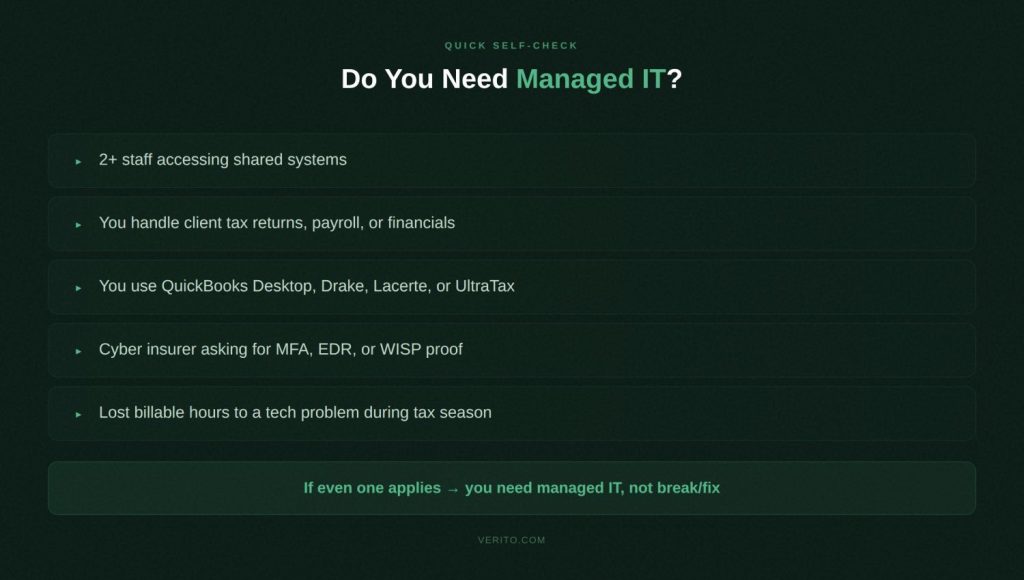
You need managed IT if:
- You have two or more staff members accessing shared systems.
- You handle any client financial data, tax returns, payroll, or business financials.
- You use QuickBooks Desktop, Drake, Lacerte, UltraTax, ProSeries, or similar software as a production environment.
- You have received a cyber insurance renewal requiring proof of MFA, EDR, backup testing, or WISP documentation.
- You have lost billable hours during tax season because of a tech problem.
- You cannot answer the question: “What would happen to your clients’ data if your main workstation was encrypted tonight?”
The FTC Safeguards Rule classifies tax preparation firms as financial institutions under the Gramm-Leach-Bliley Act, which means most accounting practices are legally required to maintain documented security controls. Non-compliance can result in fines up to 100,000 dollars per violation, with personal liability of up to 10,000 dollars per violation for firm leaders.
Managed IT does not just reduce the risk of a cyberattack. It produces documentation that proves compliance when an auditor asks. Approximately 65 percent of IT budgets at businesses without managed services are consumed by maintaining existing systems rather than improving them, according to Market.us’ Managed Services Provider market research, which means firms operating on break/fix often spend more than they realize without getting the proactive protection they actually need.
What to Look for in a Managed IT Provider for Your Accounting Firm
Not every managed service provider understands the accounting environment, and the gap between a generalist MSP and a specialist becomes obvious the first time your bookkeeper calls for help and has to explain what CCH Axcess is.
When evaluating providers, look for demonstrated accounting software expertise covering Drake, Lacerte, QuickBooks Desktop, UltraTax, and ProSeries. Confirm that compliance support is built into the service tier rather than sold as an add-on. Verify response time guarantees, especially coverage during January through April, when your tolerance for delays is zero.
Ask whether the provider holds a SOC 2 Type II certification, which is the independent audit standard confirming their security controls are tested and documented. Confirm month-to-month flexibility rather than multi-year lock-in, and get transparent per-device pricing with no usage-based surprises.
For a closer look at what accounting-specific IT support involves end-to-end, the guide to IT support for accounting firms covers the full scope of what a purpose-built provider should deliver.
A managed IT provider worth trusting does not just keep your systems running today. They help you future-proof your firm’s IT infrastructure so that growth, new hires, and additional locations do not create new vulnerabilities.
Frequently Asked Questions
1. How much does managed IT cost for an accounting firm in 2026?
Most accounting firms pay between $79 and $200 per device per month for managed IT in 2026. The lower end covers core IRS compliance, monitoring, and helpdesk support. The higher end includes full-spectrum endpoint security, anti-phishing, immutable backups, annual risk assessments, and comprehensive IT management. VeritGuard’s Essentials tier starts at $79 per device per month with a one-time $100 per device setup fee.
2. What is the difference between break/fix IT and managed IT services?
Break/fix IT charges an hourly rate when something goes wrong. Managed IT is a flat monthly fee that covers proactive monitoring, patch management, security, backups, and unlimited support year-round. The primary difference is posture: break/fix responds to problems, managed IT works to prevent them from occurring in the first place.
3. What should managed IT services for a CPA firm include?
At a minimum, a managed IT package for a CPA firm should include 24/7 system monitoring, unlimited helpdesk support, patch management for all operating systems and software, endpoint security with EDR, managed and tested backups, MFA deployment, and compliance documentation covering the FTC Safeguards Rule, IRS Publication 4557, and WISP requirements. Higher tiers add anti-phishing, immutable offline backups, staff security training, and annual risk assessments.
4. Do accounting firms need managed IT services or just cybersecurity tools?
Most accounting firms need both, and in practice they are the same thing. Standalone cybersecurity tools require someone to monitor alerts, respond to incidents, update configurations, and maintain compliance records. Managed IT bundles all of that under one agreement and one monthly fee, so your firm is protected continuously rather than only when someone remembers to check a dashboard.
5. Is there a managed IT service built specifically for tax software like Drake and Lacerte?
Yes. Verito’s VeritGuard is purpose-built for tax and accounting workflows. Every engineer goes through the VeritCertified program, which includes hands-on training specifically for Drake, Lacerte, UltraTax, QuickBooks Desktop, ProSeries, and CCH Axcess. That specialization is what produces the 92% First Touch Resolution rate: issues are resolved by the first engineer who picks up the call, without escalation or callbacks.
6. Can I get managed IT without signing a long-term contract?
Yes. VeritGuard operates month-to-month with no annual commitment. The only upfront cost is a one-time $100 per device setup fee covering configuration, security deployment, and employee training. Cancellation requires 30 days notice, no penalty fees, and Verito will coordinate a full data handover to your next provider.
7. What is the difference between VeritGuard and VeritSpace?
VeritGuard is Verito’s managed IT service for your local devices, covering security, monitoring, helpdesk support, and compliance management. VeritSpace is Verito’s dedicated private cloud hosting service for tax and accounting software like Drake, Lacerte, QuickBooks, and UltraTax. Many firms use both through VeritComplete, which bundles them together at a 20% savings compared to purchasing separately.
The Bottom Line: Your Firm Cannot Afford to Wait
Technology problems in an accounting practice are never just IT problems.
A server that goes offline on April 12th is a client relationship problem. A missing WISP found during an audit is a regulatory problem. A ransomware attack that encrypts three years of client files is an existential problem. Every one of those scenarios is preventable, and every one of them costs far more to recover from than any managed IT contract would have.
The managed services market exists because the cost of doing nothing has become undeniable.
Flat-fee, proactive IT support has moved from a luxury that large firms use to a baseline that firms of every size need. The accounting practices that will thrive over the next decade are not necessarily the ones with the best tax software or the sharpest CPAs, though both matter. They are the ones that have built IT infrastructure reliable enough to stay invisible during the moments when their clients are counting on them most.
For most accounting firms reading this, the decision is not really whether to adopt managed IT. It is how quickly to make the switch, and which provider actually understands your work.