
When a PE acquisition hits your accounting firm, IT is one of the first things to change.
You built your firm over years, maybe decades. Now a private equity group is acquiring it. The conversations so far have focused on valuation, client retention, and leadership roles. But there is one topic that rarely gets enough attention before the ink dries: what happens to your accounting firm IT after a PE acquisition.
IT keeps your firm running every single day. When ownership changes, technology has to change with it. Here is what to expect and how to prepare.
How PE Acquisition Changes Your Accounting Firm IT
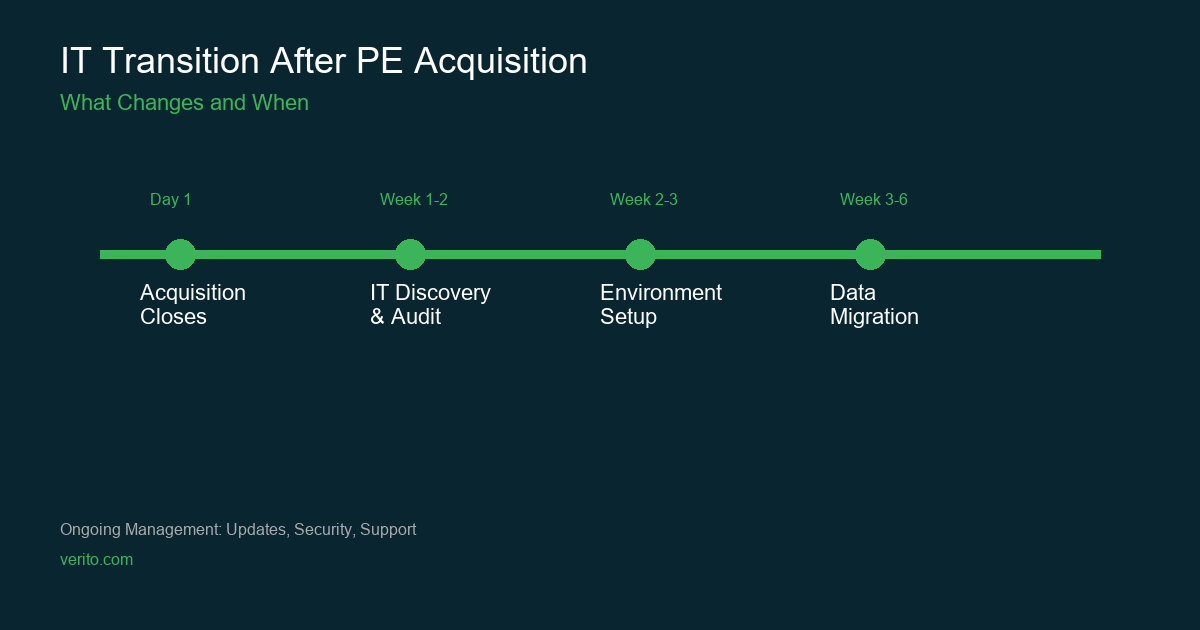
On day one, most things look the same. Your team logs in, opens their tax software, and serves clients. Nothing feels different yet.
Behind the scenes, though, things are already shifting. The PE group’s operations team is evaluating your current setup. They are reviewing your software, your data storage, your security posture, and how your systems compare to other firms in their portfolio.
This is normal. It is also the beginning of a process that will touch every part of your technology stack over the coming weeks and months.
What Your New PE Partner Expects from IT
Private equity operators think about accounting firms differently than most firm owners do. They are managing a portfolio of firms, not just one. That changes what they need from technology.
Standardization Across the Portfolio
PE groups want every firm running on a consistent platform. This makes it easier to manage, easier to secure, and easier to scale.
If one firm uses Lacerte and another uses Drake, that is fine. But the underlying infrastructure needs to be uniform. That includes:
- The cloud environment (dedicated, not shared)
- Security tools (MFA, encryption, monitoring)
- Backup and recovery systems
- Help desk and support channels
For a deeper look at how this works in practice, see our guide on managed IT services for accounting firms.
Security and Compliance After PE Acquisition
PE operators carry significant liability across their portfolio. A data breach at one firm creates risk for the entire group.
They expect every firm to meet a baseline security standard, including:
- Multi-factor authentication on all accounts
- Encrypted storage for client data
- Regular security monitoring and threat detection
- Compliance with FTC Safeguards Rule and IRS Publication 4557
If your firm has been running on a basic setup, expect that to change quickly.
Reporting and Visibility
PE groups want to see how technology is performing across their portfolio. That means centralized monitoring, usage reports, and cost tracking. Your IT can no longer be a black box.
The Three Things That Break First
Every PE acquisition is different. However, certain accounting firm IT problems show up again and again in the first 30 to 60 days.
1. Email and Communication
Email migrations are one of the most disruptive parts of any IT transition. If the acquiring group wants all firms on the same email platform, your team faces:
- Moving mailboxes and archives
- Updating email signatures
- Reconfiguring shared calendars
- Making sure nothing falls through the cracks during tax season
This is manageable, but it needs to be planned carefully.
2. File Access and Storage
Your team has years of client files stored somewhere. Maybe it is a local server, maybe a cloud drive, maybe a mix of both.
When the PE group consolidates storage, your team needs to know where their files went and how to access them. Poor communication here leads to lost productivity and frustrated staff.
3. Software Licenses
Accounting firms rely on a web of software licenses: tax prep, document management, scanning tools, practice management systems.
During a PE acquisition, accounting firm IT license ownership often gets tangled. Some licenses are tied to the old firm entity. Others are per-user and need to be re-provisioned. Sorting this out early prevents surprises later.
For context on what tax software hosting involves, check our complete tax software hosting guide.
How IT Standardization Works After a PE Acquisition
If you have never been through an IT standardization process, it can feel overwhelming. However, when it is done well, it follows a predictable path.
Step 1: Discovery
The IT team audits what you currently have. Every application, every device, every user account, every subscription. This gives them a clear picture of your starting point.
Step 2: Environment Setup
Your firm gets provisioned on the standardized platform. This usually means a dedicated cloud environment with all the security tools, monitoring, and backup systems already in place. Your tax software gets installed and configured in this new environment.
Step 3: Migration
Your data, files, and user accounts move to the new platform. This is done in stages, starting with less critical systems first. Good IT providers do this with minimal downtime, often over a weekend.
Learn more about what a strong IT partner looks like in our ranking of the best IT support providers for accounting firms.
Step 4: Ongoing Management
Once the migration is complete, your firm is on the same platform as every other firm in the portfolio. Updates, security patches, and monitoring all happen centrally. Your team gets a single help desk to call when something goes wrong.
The whole process typically takes a few weeks, not months.
Is your accounting firm going through a PE acquisition? Verito helps PE-backed firms standardize, secure, and scale their IT. Talk to our team about your transition.
What to Ask Your IT Provider Before the Deal Closes
If your accounting firm is in the middle of a PE acquisition, ask these questions about IT:
- What is the timeline for IT changes? Get a clear picture of when things shift and how long the transition takes.
- Will my team’s tax software change? Most PE groups let firms keep their preferred software. The infrastructure underneath changes, not the applications.
- How will data be migrated? Ask about the process, the timeline, and what happens if something goes wrong.
- What does security look like on the new platform? Understand the baseline standards and how they compare to what you have today.
- Who does my team call for support? A single, responsive help desk matters more than you might think.
- What happens to our existing IT vendor? Clarify whether they will be replaced and when.
- Will there be downtime during migration? Your clients do not care about your acquisition. They care about getting their returns filed on time.
The Bottom Line
A PE acquisition does not have to mean IT chaos for your accounting firm. With the right planning and the right technology partner, the transition can be smooth for your team and your clients.
The firms that handle this well are the ones that ask the right questions early and work with providers who understand the unique demands of accounting. See how other firms are solving their IT challenges in our guide: How CPA Firms Are Solving Their Biggest IT Problem.
Frequently Asked Questions
Does a PE acquisition mean my accounting firm has to switch tax software?
Usually not. Most PE groups standardize the infrastructure, not the applications. Your team keeps using Drake, Lacerte, ProSeries, or whatever software they know. The cloud environment, security, and support underneath is what changes.
How long does the accounting firm IT transition take after a PE acquisition?
For most firms, the full process from discovery to completion takes two to six weeks. The timeline depends on the complexity of your current setup and how many firms are being standardized at the same time.
Will there be downtime during the technology migration?
Good IT providers plan migrations with minimal or zero downtime. Most firms schedule the cutover for a weekend or low-activity period. Your team should be able to log in and work normally the following Monday.
What happens to our current IT vendor after the PE acquisition?
In most cases, the PE group replaces individual IT vendors with a single managed IT provider for the entire portfolio. This gives them consistent security, support, and cost control across all firms.
What security standards do PE groups expect from acquired accounting firms?
At minimum, PE operators expect multi-factor authentication, encrypted storage, automated backups, and continuous monitoring. Most also require compliance documentation for the FTC Safeguards Rule and IRS Publication 4557.
Verito helps PE-backed accounting firms standardize, secure, and scale their IT across every firm in the portfolio. Learn how we work with PE groups and their firms.








![IRS Publication 4557 & WISP Compliance for Accounting Firms [FULL Guide]](https://verito.com/blog/wp-content/uploads/2025/10/IRS-Publication-4557-WISP-Compliance-for-Accounting-Firms-FULL-Guide-380x220.jpg)
